Why I Built Ticketfolio
There used to be a drawer. Almost everyone had one — a drawer, a shoebox, a page in a book somewhere — where the tickets ended up. Boarding passes with the corner torn off. Museum admissions gone soft from a back pocket. The concert stub with the date you don't need to look up, because you remember.
Then, quietly, over about a decade, the tickets stopped arriving. Boarding passes moved into airline apps and started expiring — the record that you flew somewhere now deletes itself two hours after you land. Museums switched to QR codes. Trains went paperless. It's all more efficient, and nobody asked what the drawer was for.
I don't think anyone kept those stubs because they loved paper. A ticket stub was doing a very specific job: it was proof, compressed. One small card that held a place, a date, and — if you wrote on the back, and people did — one line about what happened. That's the entire anatomy of a memory. Nothing else we produce while traveling is that dense. Certainly not what replaced it.
What replaced it
Photos. Two thousand of them per trip, by most counts. I take them too — and I noticed what I suspect you've noticed: the more photos a trip produces, the less any single one of them means. The camera roll is where trips go to blur together. We have never recorded so much and remembered so little of it.
The problem isn't the photos. The problem is that a pile isn't a keepsake. A keepsake is selected — somebody chose it, dated it, kept it on purpose. That act of choosing is the memory work, and the stub was the form that made the work take thirty seconds instead of a weekend of scrapbooking.
So I built a ticket counter
Ticketfolio does one narrow thing: it takes a photo you already have and prints it — on screen, and on paper if you want — as the ticket that trip never gave you. You pick the shot, stamp the city, the country, the date, and write one line to your future self. The colors come from the photo itself, so the stub looks like it was printed the same day, in the same light. It gets a serial number and goes in your collection, next to the last one.
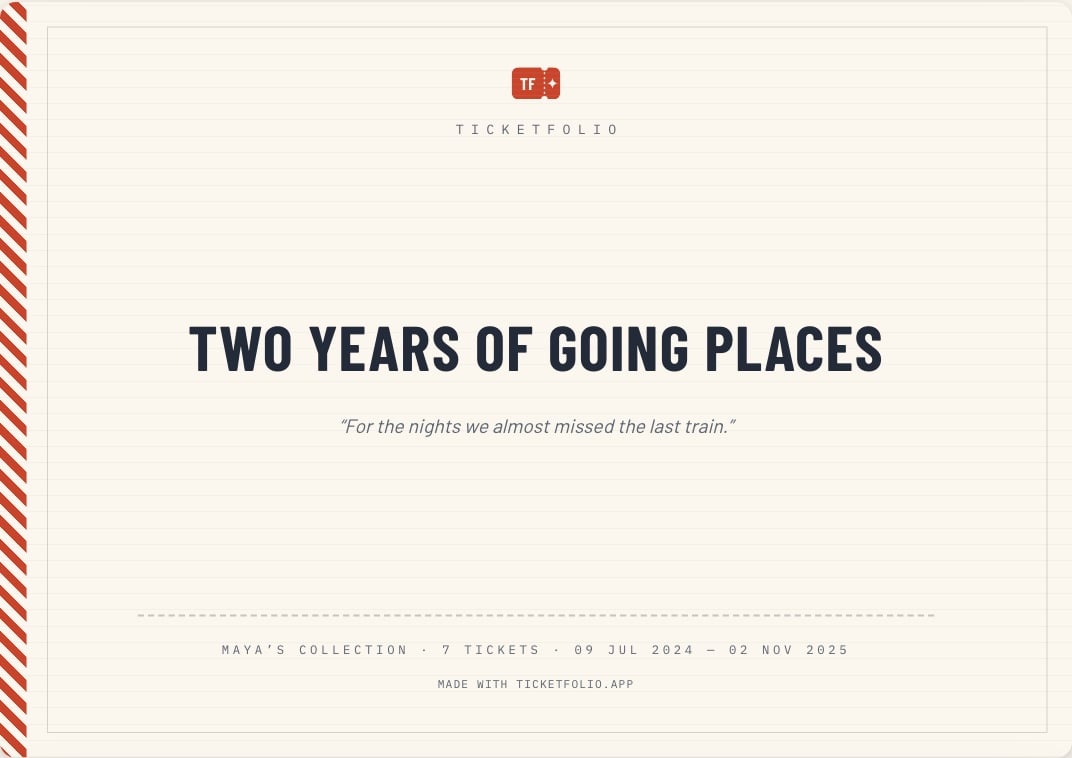
From there the collection can leave the screen: a single stub as a sharp PNG, a trip as one tall travel strip, or the whole journey as an A5 booklet, one ticket per page, that comes off a home printer and goes on a shelf. The shelf matters. Things on shelves get picked up again; things in clouds don't.
The name
A folio, in the old sense, is a leaf of paper — and a binder you keep leaves in. Ticket + folio: a folder of stubs. I wanted the name to promise the boring part, the keeping, because the keeping is the product. Anyone can generate a pretty card. The point is where it's filed, and that it's still there next year.
A few deliberate choices
It's private by default. Your collection is yours; photos are stored for your account and used for nothing else. There's no feed inside Ticketfolio, no likes, no algorithm deciding which of your memories deserves attention. If you want to share a strip, you export it and post it wherever you already live online.
The free plan is actually free. Three tickets, forever, with every feature — full editor, all templates, PNG export, the booklet, the strip. If the format works on you, Plus is $29.99 a year for unlimited tickets, and that's the entire difference. I'd rather have a thousand people with three real tickets than lock the good parts behind a gate.
It's small on purpose. One person builds this. That's not a hardship story — it's why the product can afford to stay narrow. No pivot to video. Just the counter, the stubs, and the drawer slowly filling up.
What I want it to become
Nothing dramatic. I want someone, a few years from now, to flip through a booklet of a trip they'd half forgotten and get the whole day back from one line they wrote in ten seconds. That's the entire ambition — the drawer, rebuilt.